
How this article was made
| Mode | “Write an article (with sections)” |
|---|---|
| AI model | Gemma 4 31B (free, via Google AI Studio) An open Google model: it works with the same key as Gemini, or on your own computer in LM Studio. |
| Topic and keywords | How to Make a Sourdough Starter from Scratch · sourdough starter, feeding a starter, sourdough for beginners |
| Style | warm and precise, like a home baker explaining it to a friend; give amounts in grams |
| Images | ClipCloud, style “photorealistic-1” |
| Length | 5,274 characters (the settings asked for 5,000 to 6,500) |
Starting your own sourdough culture is the best way to get a deep, complex flavor in your bread without using store-bought yeast. It feels like magic when simple flour and water come alive, giving you total control over the texture and taste of your loaves.
You only need a few basic tools to begin. I will show you how to mix 50g of flour with 50g of water to start your colony. We will go through the daily feeding routine and how to tell exactly when your starter is strong enough to bake a good loaf.
Essential Tools and Ingredients
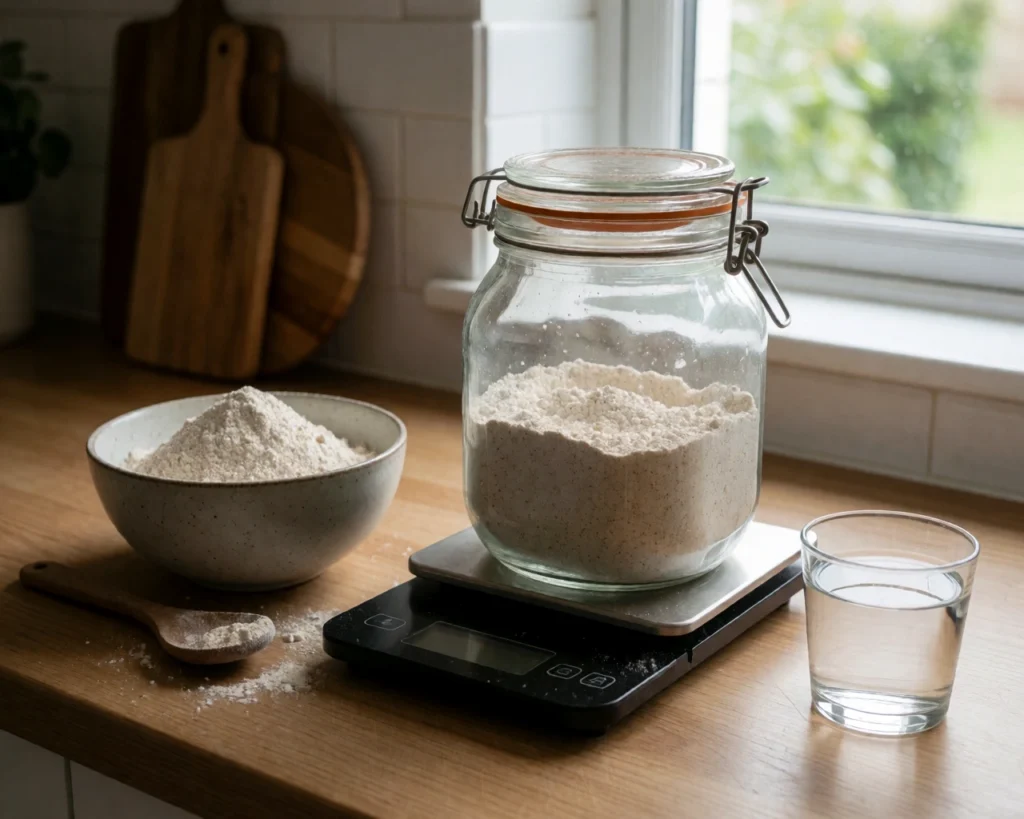
You don’t need a professional kitchen to get this right, but a few specific items make the process much smoother. Accuracy is key when working with wild yeast, so put away the measuring cups and use a digital scale.
Ingredients
- Flour: Start with whole wheat or rye flour. These contain more nutrients to jumpstart the fermentation. Later, you can switch to unbleached all-purpose or bread flour for daily feedings.
- Water: Lukewarm filtered water. Chlorine in some tap water can hinder yeast growth, so filtered is safer.
Equipment
- Glass Jar: A wide-mouth jar with a capacity of about 1 liter. This gives your starter plenty of room to expand without overflowing.
- Digital Scale: This ensures your ratios stay consistent every single day.
- Spatula: A small silicone spatula is perfect for scraping the sides, which prevents dried bits from molding.
- Rubber Band: A simple band wrapped around the glass helps you track exactly how much the mixture rises.
Step-by-Step Mixing Process
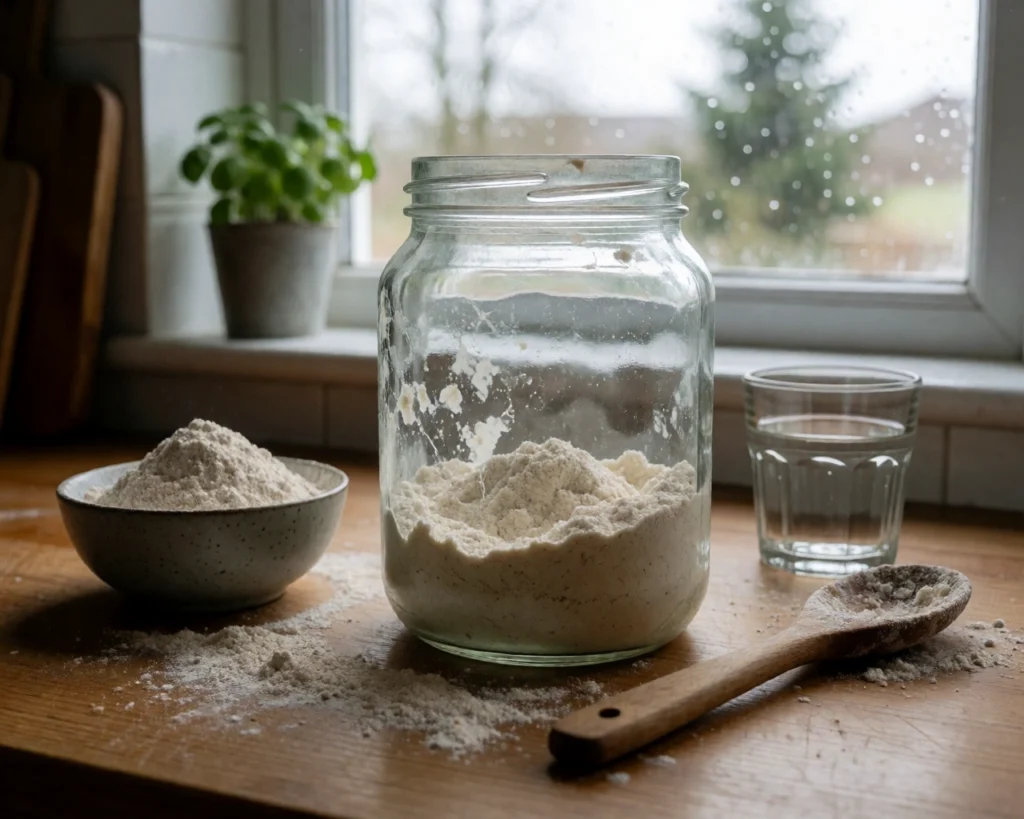
Start by placing your glass jar on the scale and setting it to zero. Mix 50g of your chosen flour with 50g of lukewarm water. Stir vigorously until no dry clumps remain. The consistency should be like a thick, sticky paste. Cover the jar loosely with a lid or a breathable cloth and let it sit at room temperature for 24 hours.
On day two, you might not see much activity, but do not worry. Remove half of the mixture and discard it. This step is vital to keep the volume manageable and ensure the yeast has fresh food. Add another 50g of flour and 50g of water. Stir thoroughly and let it rest for another day.
From day three onward, follow this specific rhythm every 24 hours:
- Discard: Remove all but 50g of the starter from the jar.
- Feed: Stir in 50g of flour and 50g of lukewarm water.
- Mix: Stir until the texture is smooth and uniform.
Continue this cycle daily. You are cultivating a colony of wild yeast and lactic acid bacteria. If you notice small bubbles forming on the surface or a slightly tangy scent, the fermentation process has begun.
Daily Feeding and Maintenance
Feeding your starter is essentially a cycle of refreshing its food source. It feels counterintuitive to throw away most of your mixture, but discarding is necessary. Without it, you would need massive amounts of flour to keep the yeast fed, and the acidity would build up too quickly, hindering growth.
The routine stays the same: keep 50g of starter and add 50g of flour and 50g of lukewarm water. Once the starter rises reliably, you can use unbleached all-purpose or bread flour for these feedings. Stir everything until smooth. The texture should be like a heavy pancake batter. Once mixed, put the lid back on loosely and let it sit at room temperature. Consistency is what builds strength, so try to feed it at the same time each day. If your kitchen is very warm, you might notice the starter peaking and falling faster. In that case, move to feeding it every 12 hours to keep the yeast vigorous and prevent it from becoming too acidic.
Identifying a Mature Starter
You will know your starter is ready when it becomes predictable. A mature culture usually doubles in volume within 4 to 8 hours after a feeding of 50g flour and 50g water. Look for a sponge-like texture filled with bubbles of various sizes, from tiny pinpricks to larger pockets of air. The smell should shift from a sharp, vinegary scent to something pleasantly tangy, similar to yogurt or a mild cider.
For an extra check, try the float test. Gently drop a small spoonful of the active starter into a glass of room temperature water. If it floats on the surface, the carbon dioxide levels are high enough for baking. It is not foolproof: rye and whole wheat starters often sink even when active, so trust the steady doubling first.
- Volume: It consistently doubles or triples in size.
- Texture: It looks aerated and mousse-like.
- Aroma: It smells sweet and sour, not like nail polish remover.
- Timing: The peak occurs at the same time every day.
Common Issues and Storage Tips
If you notice a thin layer of dark liquid on top, do not panic. This is hooch, a natural byproduct that means your starter is hungry. You can stir it back in for a more sour flavor or pour it off before feeding your culture 50g of flour and 50g of water.
Keep a close eye out for actual mold. If you see fuzzy patches or colors like pink or orange, the culture is contaminated. In this case, throw it away and start fresh.
When you are not baking daily, the refrigerator is your best friend. It slows down the fermentation process so you only need to feed it once a week.
| Storage Method | Feeding Frequency | Amount per Feed |
|---|---|---|
| Room Temperature | Every 24 hours | 50g flour / 50g water |
| Refrigerator | Once a week | 50g flour / 50g water |
To wake up a chilled starter, bring it to room temperature and feed it 50g of flour and 50g of water. Wait for it to double in size before mixing your dough.
This text was generated by ClipAI and the pictures by ClipCloud, to show how the programs work. Pages without this note are written by people.
 English
 RU_RU