
How this article was made
| Mode | “Write an article (with sections)” |
|---|---|
| AI model | GLM 4.7 Flash (free, on your own computer via LM Studio) |
| Topic and keywords | How to Brew Green Tea So It Is Not Bitter · brew green tea, green tea temperature, steeping time, loose leaf tea |
| Style | friendly and precise, with temperatures and times. No health claims |
| Images | ClipCloud, style “photorealistic-1” |
| Length | 3,962 characters (the settings asked for 3,000 to 4,000) |
Green tea can taste sweet, fresh and gently grassy, but too much heat or too long a steep turns it bitter and mouth-drying. That harsh cup is what puts many people off green tea, and it is usually a brewing problem rather than a bad tea.
Below you will learn how to choose teaware, how much loose leaf to use, which water temperature suits which tea and how long to steep it. The short version: water between 160 and 180°F (70 and 80°C), about 2 to 3 grams of leaf per cup and one to two minutes in the pot.
Choosing the Right Teaware for Loose Leaf Green Tea
The right vessel makes it easy to stop the infusion on time. A gaiwan, a small lidded bowl from China, is a good choice: the leaves have room to open, you can see them, and you can pour off the tea in a couple of seconds. A Japanese kyusu, a small teapot with a side handle and a built-in strainer, works just as well for sencha. If you use an ordinary teapot, pick one with a wide mouth and enough room for the leaves to expand, and use a roomy basket infuser rather than a small tea ball, which packs the leaves too tightly.
Porcelain and glass are both good materials: they do not hold on to flavors, and glass lets you watch the leaves unfurl. Warm the vessel with a splash of hot water before you add the leaves, so the brewing water does not lose too much heat. Rinse your teaware with plain hot water after each session: old tea residue leaves stale flavors behind, and soap residue spoils the next cup.
Controlling Water Temperature for Optimal Flavor
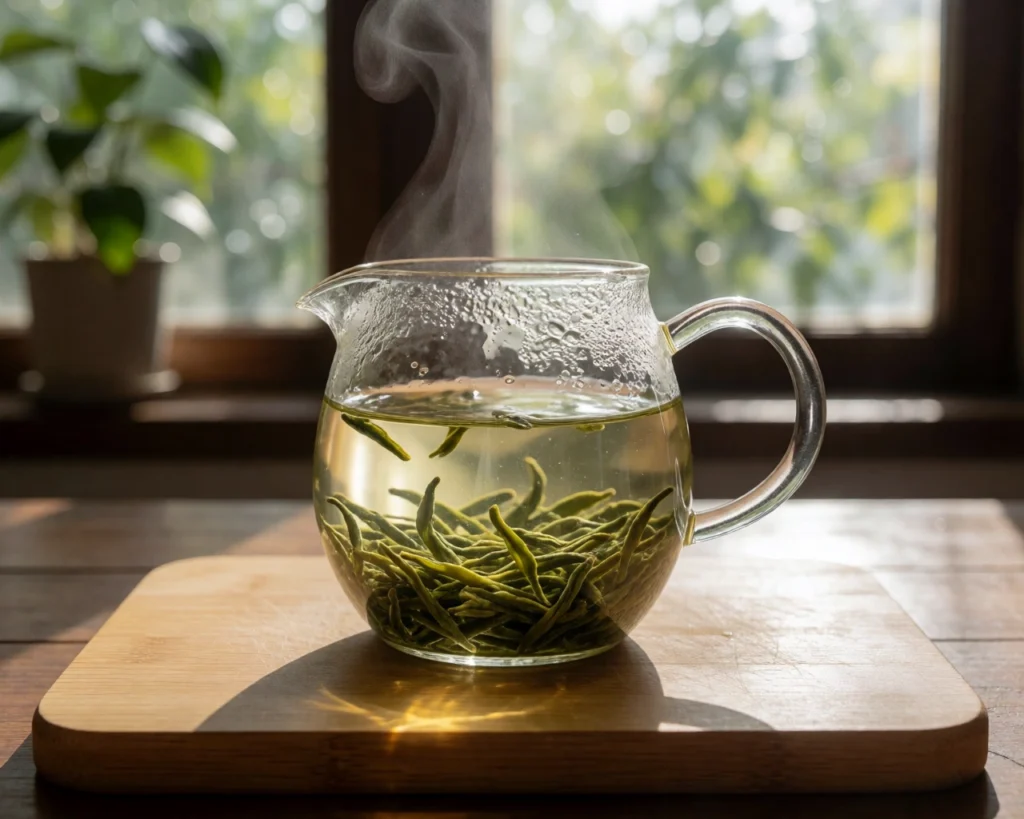
Water temperature is one of the biggest factors in preventing bitterness. Boiling water pulls bitter catechins out of the leaves very quickly and flattens the delicate, sweet notes. For most green teas, aim for 160 to 180°F (70 to 80°C). A kettle with temperature settings or a thermometer makes this easy. Without one, let freshly boiled water stand with the lid open for a few minutes, or pour it into an empty cup first: each transfer to a room-temperature vessel takes off several degrees. Use these targets as a starting point:
- 140°F (60°C) or lower: gyokuro and other shade-grown Japanese teas, prized for their sweet, savory flavor
- 160 to 175°F (70 to 80°C): sencha and most everyday Japanese green teas
- 175 to 180°F (about 80°C): Chinese pan-fired teas such as Dragon Well (Longjing) and jasmine green tea
If a tea still tastes harsh at these temperatures, lower the heat by about 10°F (5°C) before you change anything else.
Using the Right Amount of Tea Leaves per Cup
Using too much leaf is the other common cause of a bitter cup. A good starting point is about 2 to 3 grams of loose leaf, roughly one level teaspoon of a fine tea such as sencha, for every 6 to 8 ounces (180 to 240 ml) of water. Bulky, flat leaves such as Dragon Well take up more room, so a teaspoon of them weighs less: use a heaped spoon or, better, a small kitchen scale. If you like a stronger cup, increase the amount gradually, up to about twice as much, and shorten the steep slightly when you do.
Gyokuro is the exception: it is traditionally brewed with more leaf and less water, at a much lower temperature, which brings out its sweetness. Whatever the tea, give whole leaves room to expand. Packed tightly into a small infuser, they cannot open fully and brew unevenly.
How to Time Your Steep to Avoid Bitterness
Timing is the last step to a clean, smooth cup. Most green teas give their best flavor in one to two minutes. Past about three minutes, the bitter compounds (often loosely called tannins) keep building up and the cup becomes harsh and drying. Fine-cut Japanese teas such as fukamushi (deep-steamed) sencha release flavor especially fast, so start them at 30 seconds to one minute. Gyokuro brewed at a low temperature is the opposite and usually needs about two minutes.
When the time is up, pour out all of the tea, down to the last drops, or lift out the infuser. Leaves left sitting in the water keep brewing. Good loose-leaf green tea can be steeped two or three times: the second infusion is often shorter, and later ones need a little longer. Taste as you go and adjust the time by 15 to 30 seconds until the cup suits you.
This text was generated by ClipAI and the pictures by ClipCloud, to show how the programs work. Pages without this note are written by people.
 Russian
 EN